
Advanced structural research requires more than a powerful actuator or a rigid reaction frame. Accurate testing depends on how the structure, actuators, sensors, controls, data acquisition, and software work together as one coordinated system.
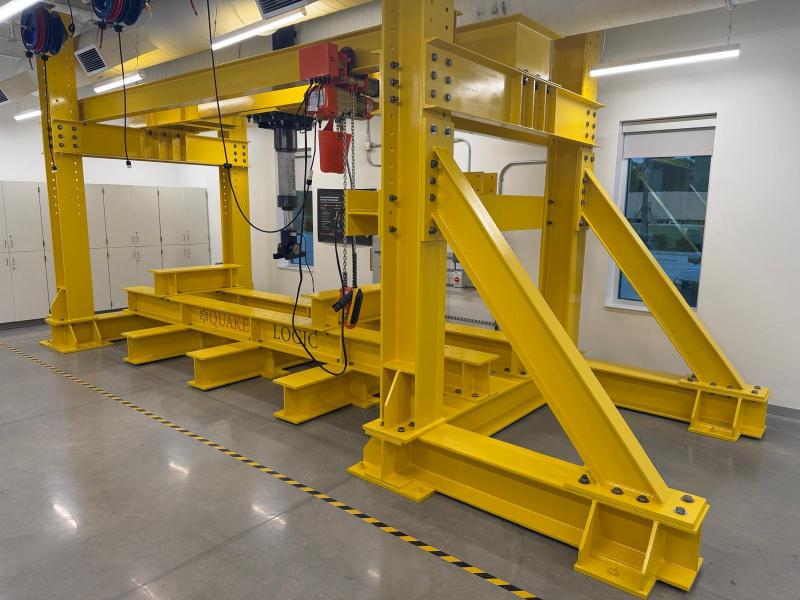
QuakeLogic’s Heavy-Duty Multi-Axis Structural Testing System was engineered around this principle. The system provides a complete turnkey platform for advanced structural testing, cyclic and dynamic loading, full-scale component evaluation, and real-time hybrid simulation.
Rather than combining unrelated components after installation, QuakeLogic approaches the laboratory as one integrated engineering system. Therefore, the mechanical structure, loading equipment, instrumentation, controls, and software can be developed around the requirements of the test program.
One Integrated Testing System
Structural testing becomes increasingly complex as specimen size, loading capacity, and experimental requirements increase. Moreover, multi-axis testing requires precise coordination between mechanical and electronic components.
The QuakeLogic multi-axis structural load frame addresses these requirements through an integrated design. It supports both horizontal and vertical loading while providing a heavy-duty structural reaction frame for demanding laboratory experiments.
The system incorporates 30 kip (133 kN) and 60 kip (267 kN) servo-electromechanical actuator capacities. In addition, the actuators provide ±5.9 in (±150 mm) stroke, allowing researchers to perform a broad range of controlled loading protocols.
Because the system uses closed-loop servo-electromechanical actuation, laboratories can achieve controlled loading without relying on a conventional hydraulic actuation system. This approach also supports a cleaner laboratory environment while reducing the infrastructure normally associated with hydraulic power systems.
See the System in Action
See QuakeLogic’s Multi-Axis Structural Testing System in action and take a closer look at the complete laboratory setup, structural reaction frame, servo-electromechanical actuation, and integrated control system.
▶ Watch the Multi-Axis Structural Testing System Video on YouTube
Built for Structural Research
A structural testing system must accommodate different research objectives. For this reason, the QuakeLogic platform supports multiple testing modes, including monotonic, cyclic, dynamic, and real-time hybrid simulation.
These capabilities make the system suitable for applications such as:
- Cyclic and dynamic structural loading
- Full-scale structural component testing
- Connection and joint testing
- Horizontal and vertical load application
- Structural behavior and performance evaluation
- Real-time hybrid simulation with numerical models
- Laboratory research and engineering education
- Advanced structural and earthquake engineering studies
As a result, researchers can use one configurable structural testing platform for a wide variety of experimental programs.
Multi-Axis Loading Control
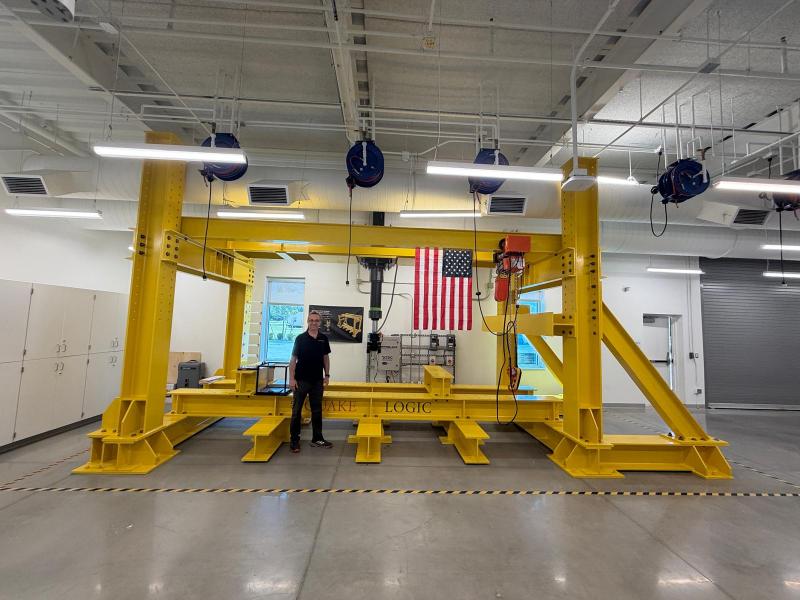
Multi-axis structural testing requires more than simply installing multiple actuators. Each actuator must interact correctly with the reaction frame, specimen, sensors, and control system.
QuakeLogic uses fully synchronized multi-actuator servo control to coordinate loading operations. Consequently, horizontal and vertical loading can become part of a unified experimental setup rather than independent subsystems.
This synchronized approach is particularly valuable when researchers need to reproduce complex structural behavior. It also creates a practical foundation for experiments in which several loading conditions must be applied and monitored simultaneously.
Furthermore, computerized operation allows researchers to manage testing through integrated control and testing software.
Precision Instrumentation
Reliable structural testing depends on reliable measurements. Therefore, instrumentation is an essential part of the complete system rather than an optional addition.
The QuakeLogic structural testing platform integrates load, displacement, and feedback sensors with data acquisition. These measurement systems provide the information required for closed-loop control while also supporting detailed experimental analysis.
The installed system shown here includes a heavy-duty swivel base, load measurement equipment, displacement sensing, a servo control panel, and the associated control infrastructure.
Together, these components help establish a closed measurement and control chain from load command to physical response.
Heavy-Duty Reaction Frame

An actuator can only apply useful force when the supporting structure can safely and accurately react against that force.
For that reason, the reaction structure is a central part of the QuakeLogic system. The purpose-built heavy structural steel frame provides the foundation for horizontal and vertical loading. In addition, the bolted specimen bed offers a practical platform for configuring experimental specimens and fixtures.
The modular bolted construction also supports application-specific laboratory configurations. Therefore, the frame can be engineered around the required test envelope instead of forcing every laboratory into the same generic configuration.
This approach is particularly important for universities, research laboratories, engineering organizations, and industrial testing facilities that may have unique specimens or experimental objectives.
Real-Time Hybrid Simulation
One of the most advanced capabilities of the system is support for real-time hybrid simulation.
Hybrid simulation combines physical testing with numerical modeling. Instead of constructing every part of a structural system physically, researchers can test critical components in the laboratory while other parts of the system are represented computationally.
The physical experiment and numerical model must interact rapidly and accurately. Therefore, actuator control, instrumentation, data acquisition, and software integration become especially important.
QuakeLogic’s integrated approach provides the foundation needed to connect physical structural experiments with numerical models. As a result, researchers can investigate complex structural responses while making more efficient use of laboratory resources.
Servo-Electromechanical Actuation

Traditional high-capacity structural laboratories are often associated with hydraulic actuators, hydraulic power units, oil lines, and related infrastructure.
The QuakeLogic system takes a different approach through servo-electromechanical, closed-loop actuation.
The 60-kip vertical actuator shown in the installation demonstrates how high-capacity loading can be incorporated directly into the structural frame. Meanwhile, the control system coordinates actuator commands and measurement feedback.
This architecture can provide an attractive solution for laboratories seeking precise structural loading while avoiding hydraulic oil and hydraulic power infrastructure.
In addition, the integrated actuator and control approach helps simplify the overall laboratory architecture.
Safety and Control
Structural testing equipment must combine performance with appropriate operational safeguards.
The system incorporates an emergency stop and interlocked servo drives as part of its safety architecture. Meanwhile, computerized control provides a central interface for system operation.
The combination of closed-loop control, feedback instrumentation, synchronized actuators, and integrated safety features helps create a more controlled testing environment.
However, every laboratory has different test specimens, capacities, fixtures, and operating requirements. Therefore, the final system configuration should always be reviewed for the specific application.
Application-Specific Engineering

Structural laboratories rarely have identical requirements. One facility may focus on connection testing, while another may investigate full-scale structural components or hybrid simulation. Similarly, required capacities, specimen dimensions, instrumentation, and control strategies can vary considerably.
For this reason, QuakeLogic approaches structural lab loading frames as engineered systems rather than generic catalog products.
Final configuration can be reviewed according to factors such as:
- Required loading capacity and direction
- Test specimen dimensions
- Required actuator stroke
- Fixture and specimen mounting requirements
- Sensor and instrumentation needs
- Controller requirements
- Data acquisition architecture
- Software integration
- Laboratory space and infrastructure
- Training and documentation requirements
This engineering review helps create a clearer connection between the research objective, technical configuration, and procurement process.
From Equipment to Laboratory
A structural testing laboratory is an ecosystem.
The reaction frame supports the applied forces. Actuators generate controlled loading. Sensors measure the physical response. Controllers process feedback. Data acquisition systems capture experimental information. Finally, software coordinates the experiment and gives researchers access to the results.
If these elements are selected independently, integration can become one of the most challenging parts of a laboratory project.
QuakeLogic addresses this challenge through a single-source approach. The company can bring together structural and mechanical engineering, actuators, servo controls, instrumentation, data acquisition, software, fabrication, installation, commissioning, and technical support within one coordinated project.
Therefore, customers receive more than individual pieces of testing equipment. They receive an engineered structural testing ecosystem designed around their application.
Why QuakeLogic
This project demonstrates QuakeLogic’s ability to deliver full-cycle engineering solutions that bring hardware, software, control, instrumentation, and intelligent system integration together within one coordinated platform.
From initial engineering and structural design to fabrication, installation, integration, and final commissioning, every component is considered as part of the complete system. This approach supports precision, reliability, maintainability, and long-term laboratory performance.
More importantly, QuakeLogic goes beyond supplying individual instruments or actuators. We engineer the infrastructure that allows those technologies to work together.
Beyond instrumentation, we build complete laboratories.
Whether you are developing a new structural engineering laboratory, expanding an existing research facility, or planning a specialized testing system, QuakeLogic can help configure the solution around your test envelope and research objectives.
Let’s build the future of your facility together. Contact QuakeLogic today to discuss your custom structural testing and laboratory requirements.
Email us at sales@quakelogic.net | Visit us at products.QuakeLogic.net
Engineering case study
Technical portfolio summary
Explore QuakeLogic’s multi-axis structural testing system for cyclic, dynamic and real-time hybrid simulation applications.


Engineering reference
Search-ready project context
Structured engineering details for readers, search engines, and AI answer systems. The statements below are derived from the visible case-study content, title, taxonomy, and QuakeLogic portfolio context.
Executive Summary
Explore QuakeLogic’s multi-axis structural testing system for cyclic, dynamic and real-time hybrid simulation applications.
Engineering Challenge
The project context centers on earthquake risk, seismic instrumentation, and reliable engineering response for the asset or facility described in the case study.
Technical Solution
The case content identifies seismic sensing, monitoring, alerting, or trip-system engineering as the core technical approach.
Technologies Used
cyclic structural testing, dynamic structural testing, earthquake engineering testing, hybrid simulation testing, laboratory loading frame, multi-actuator control, multi-axis structural testing system, QuakeLogic
Industries Served
Energy and critical infrastructure
Engineering Disciplines
Testing laboratory deployment; Seismic sensing and alerting
Results / Benefits
The case study documents the project context, engineering discipline, technology focus, and related QuakeLogic portfolio work without adding unsupported performance claims.
Topic pathways
Related QuakeLogic engineering resources
Relevant QuakeLogic product and topic pages connected to this case-study context.
Project consultation
Plan a monitoring, testing, simulation, or instrumentation project with QuakeLogic.
Share the asset, hazard, laboratory workflow, or instrumentation challenge. QuakeLogic can help scope sensors, acquisition, software, commissioning, and long-term support.
QuakeLogic knowledge platform
Related products, articles, and engineering entities
These pathways are selected from the approved entity map and existing public content for this case-study topic.